Sustainability
Our carbon footprint
What is a carbon footprint?

A carbon footprint is an indicator designed to measure the environmental impact of an activity – particularly the production and consumption of goods and services – and, more specifically, the greenhouse gas (GHG) emissions associated with that activity.
Whilst there are six main greenhouse gases, all of which contribute to global climate change to varying degrees, the carbon footprint is generally expressed in carbon dioxide equivalent or CO2e.
In fact, in the interests of standardisation and to calculate and compare the impact of these gases, the IPCC (Intergovernmental Panel on Climate Change) has established this system known as CO₂ equivalence.
There are also various recognised measurement protocols and methodologies, such as the GHG Protocol (Greenhouse Gas Protocol), the ISO 14064-1 standard, and the Bilan Carbone® scheme established by ADEME (the French Environment and Energy Management Agency).
The 3 scopes of the carbon footprint
The scope of the carbon footprint calculation is commonly referred to as a ‘scope’ and is divided into 3 levels, as specified below:
- Scope 1: direct GHG emissions, i.e. those resulting directly from the activity itself;
- Scope 2: indirect emissions associated with energy, primarily electricity;
- Scope 3: all indirect emissions generated upstream (suppliers) and downstream (product use).
LALUX carried out its first carbon footprint calculation in 2023, but decided to change its methodology and service provider for 2025. This new approach is based on physical rather than monetary values, ensuring better data quality and a more reliable measurement of emissions.
This new assessment lays a solid foundation, initially for Scope 1 and 2 emissions. At the same time, LALUX has begun collecting the data required to calculate certain indirect emissions falling under Scope 3 and is actively working on developing its calculation methodology for this scope.
Nevertheless, recognising the complexity and scale involved in measuring indirect emissions, LALUX has decided to publish its Scope 3 data gradually, as its calculation methodology progresses and information becomes available.
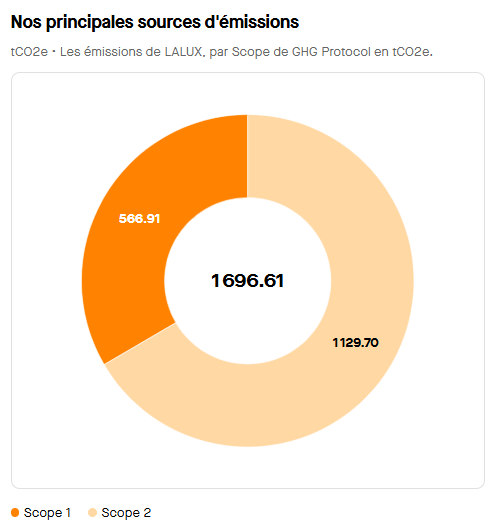
LALUX’s emissions come from:
- Scope 1: 566.91 tCO₂e
These emissions are mainly linked to the combustion of fossil fuels by the heating system and the emergency generator (559.18 tCO₂e). A small proportion of the emissions comes from company vehicle journeys (7.74 tCO₂e).
- Scope 2: 1,129.70 tCO₂e
These are linked to the company’s electricity consumption. This figure is calculated using an emission factor based on Luxembourg’s energy mix, which includes fossil fuels. However, the electricity that LALUX purchases from its energy supplier is certified as being exclusively from renewable sources, technically producing 0 tCO₂e of emissions.
Let's cut back!
Although calculating one’s carbon footprint is not a mandatory requirement, LALUX believes it is essential to start doing so on a regular basis, in order to become aware of one’s emissions and monitor how they change over time.
Understanding what these emissions consist of enables us to establish a relevant, realistic and appropriate ‘carbon reduction pathway’.
By taking responsibility on this issue in particular, LALUX is doing its bit to contribute to this massive undertaking, which requires a gradual but genuine reduction in our greenhouse gas emissions at both European and global levels.